1. Federal Underwriting Guidelines for Crawl Space Moisture and Biological Growth
Mortgage underwriting guidelines enforce strict structural health standards across all government-backed and conventional residential mortgages. Under Section 4000.1 of the FHA Single Family Housing Policy Handbook and Department of Veterans Affairs (VA) Pamphlet 26-7, foundation crawl spaces must remain free of standing.
Mortgage underwriting guidelines enforce strict structural health standards across all government-backed and conventional residential mortgages.
Under Section 4000.1 of the FHA Single Family Housing Policy Handbook and Department of Veterans Affairs (VA) Pamphlet 26-7, foundation crawl spaces must remain free of standing water, active fungus, wood-decaying organisms, and excessive dampness before underwriters issue loan commitments.
Real estate appraisers flag subfloor crawl space deficiencies on Fannie Mae Form 1004 whenever visual inspection reveals white efflorescence, dark fungal hyphae on Douglas fir floor joists, or sagging fiberglass batt insulation.
Mortgage underwriters automatically mark loan applications as 'Suspended – Pending Environmental Clearance' whenever an appraiser checks the 'Subject to Repairs' condition on appraisal documentation.
Conventional loan programs managed by Fannie Mae and Freddie Mac require that any condition threatening property structural durability or occupant safety must be professionally remediated prior to closing.
Uncertified cosmetic treatments fail lender re-inspections because underwriters mandate an unbroken chain of documentation from a certified environmental remediation firm verifying that underlying moisture sources were permanently resolved.
2. The Physics of Soil Evaporation and Structural Wood Decay in Crawl Spaces
Uncovered dirt crawl space floors release 10.0 to 15.0 gallons of moisture vapor daily per 1,000 square feet into subfloor framing cavities. Groundwater vapor transmits upward through permeable soil, creating sustained relative humidity levels exceeding 75.0% inside enclosed foundation perimeter walls.
Uncovered dirt crawl space floors release 10.0 to 15.0 gallons of moisture vapor daily per 1,000 square feet into subfloor framing cavities. Groundwater vapor transmits upward through permeable soil, creating sustained relative humidity levels exceeding 75.0% inside enclosed foundation perimeter walls.
Wood-destroying fungi (including Serpula lacrymans, Coniophora puteana, and cellulolytic Stachybotrys species) colonize subfloor plywood and load-bearing timber once wood moisture equivalent (WME) readings surpass 19.0%.
Fiberglass batt insulation installed between floor joists absorbs ambient groundwater vapor like a sponge, sagging under water weight and trapping saturated moisture against bare structural subflooring.
Because 50.0% of first-floor indoor air originates in the crawl space via the Stack Effect, volatile organic fungal compounds and mycotoxins infiltrate residential living areas, generating noticeable musty odors that alert buyers and appraisers during property walkthroughs.
Eliminating ground soil vapor transmission represents the single most important step in establishing long-term structural habitability.
3. The 4-Step Engineering Protocol to Overcome Loan Suspensions
Certified environmental contractors satisfy strict lender underwriting requirements by executing a standardized subfloor restoration and moisture control protocol. First, remediation crews establish negative-pressure containment zones to prevent airborne spores from entering finished living areas. Second, technicians extract water-logged fiberglass batt insulation in.
Certified environmental contractors satisfy strict lender underwriting requirements by executing a standardized subfloor restoration and moisture control protocol. First, remediation crews establish negative-pressure containment zones to prevent airborne spores from entering finished living areas.
Second, technicians extract water-logged fiberglass batt insulation in sealed 6-mil polyethylene disposal bags, removing biological reservoirs permanently from the foundation cavity.
Third, restoration specialists decontaminate all subfloor framing assemblies (such as Douglas fir floor joists, rim boards, sill plates, and subfloor plywood) using abrasive brushing and EPA-registered botanical antimicrobials.
Fourth, technicians deploy industrial low-grain refrigerant (LGR) dehumidifiers alongside HEPA 500 air scrubbers operating at 99.97% efficiency down to 0.3 microns, drying structural wood framing until moisture readings drop below 14.0% WME across all structural load-bearing members.
4. 20-Mil Reinforced Encapsulation Engineering Standards
Commercial 20-mil cross-laminated polyethylene membranes stop 100.0% of soil moisture transmission into crawl space cavities. Unlike thin 6-mil hardware store plastic that tears under foot traffic, reinforced 20-mil membranes incorporate heavy polyester scrim cords providing over 150 pounds of puncture resistance.
Commercial 20-mil cross-laminated polyethylene membranes stop 100.0% of soil moisture transmission into crawl space cavities. Unlike thin 6-mil hardware store plastic that tears under foot traffic, reinforced 20-mil membranes incorporate heavy polyester scrim cords providing over 150 pounds of puncture resistance.
Technicians overlap all floor seams by 12.0 inches, bonding joints with waterproof butyl mastic tape and mechanical masonry fasteners anchored into foundation perimeter walls.
The vapor membrane extends 6.0 inches above the exterior grade line, establishing an airtight envelope that satisfies the International Residential Code (IRC Section R408.3) for unvented crawl spaces.
Dedicated commercial dehumidifiers (such as Santa Fe or Quest low-grain refrigerant systems) maintain continuous indoor moisture control below 50.0% relative humidity indefinitely, eliminating the ambient dampness required for dormant fungal spores to germinate on structural timber.
5. Satisfying Appraiser Re-Inspections and FHA Form HUD-92051
FHA and VA loan officers require formal verification before releasing final loan commitment disclosures and scheduling closing settlements. Following physical remediation and encapsulation, the lender orders an official re-inspection using FHA Form HUD-92051 (Compliance Inspection Report) or assigns a VA fee inspector.
FHA and VA loan officers require formal verification before releasing final loan commitment disclosures and scheduling closing settlements.
Following physical remediation and encapsulation, the lender orders an official re-inspection using FHA Form HUD-92051 (Compliance Inspection Report) or assigns a VA fee inspector to verify that all structural deficiencies were resolved in accordance with federal standards.
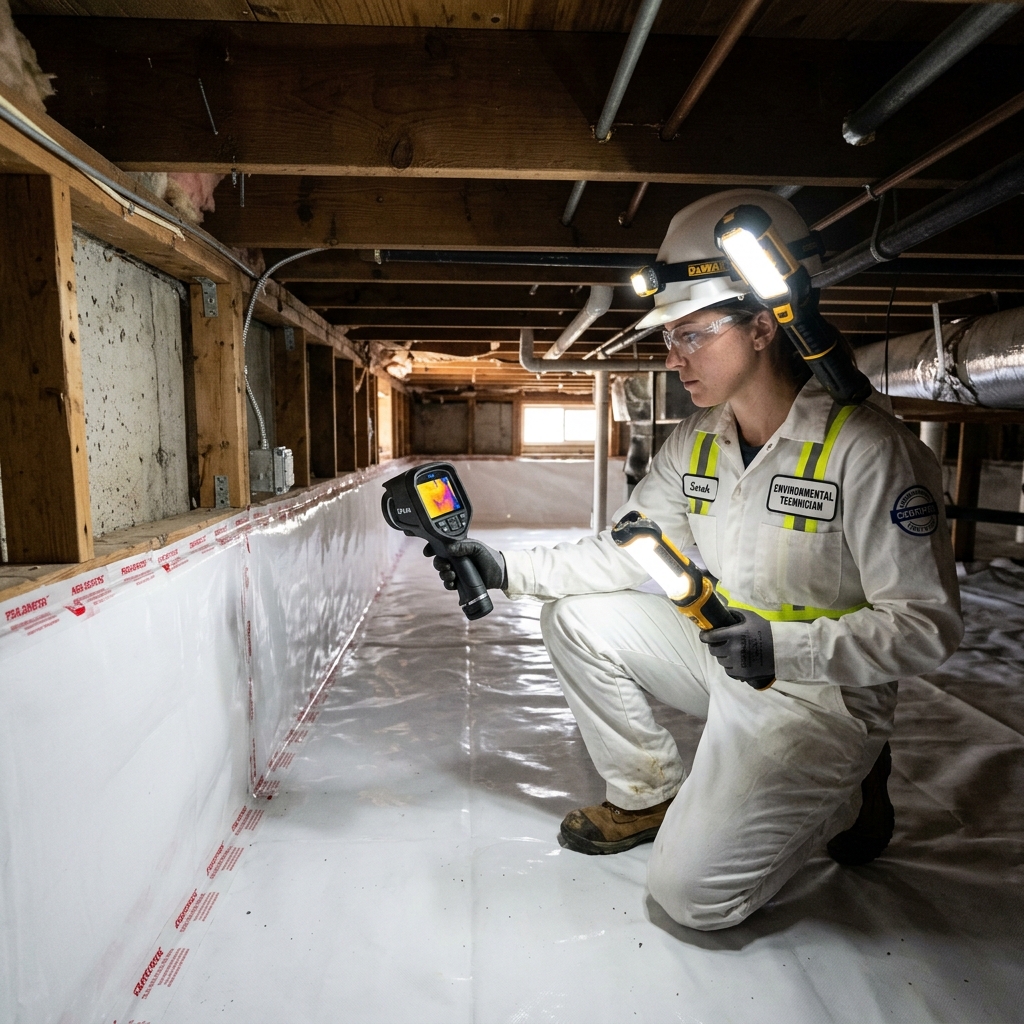
The certified remediation firm furnishes the inspector with digital date-stamped moisture mapping logs, photographic proof of 20-mil perimeter wall bonding, and an itemized Certificate of Completion.
The fee appraiser inspects the crawl space under 500-lumen illumination, confirming zero standing water, zero visible mold colonization, and verified subfloor relative humidity below 55.0%, signing the compliance certification within 24 hours.
6. Issuing the Underwriting Clearance Package and Final Sign-Off
Mortgage underwriters clear loan suspensions within 24 hours of receiving an official Environmental Clearance Letter from a certified remediation company. The clearance package contains calibrated wood moisture readings across all structural floor joists, digital date-stamped thermal photographs of the encapsulated foundation, and.
Mortgage underwriters clear loan suspensions within 24 hours of receiving an official Environmental Clearance Letter from a certified remediation company.
The clearance package contains calibrated wood moisture readings across all structural floor joists, digital date-stamped thermal photographs of the encapsulated foundation, and an itemized Certificate of Completion signed by a certified IICRC environmental specialist.
Lenders require documentation verifying structural wood moisture equivalent (WME) levels have normalized below 14.0% across sill plates, rim joists, and subfloor sheathing.
Providing third-party laboratory air testing results confirms Condition 1 normal fungal ecology, enabling the loan officer to release the final closing disclosure and approve property title transfer without escrow delays.
Authored by Antonio
Lead Environmental Health & IICRC Certified Remediation Specialist • Technical Standards Division • Emergency Mold Inspection Network
Related Real Estate & Inspection Guides
Real Estate Guide Failed Home Inspection Due to Attic Mold: How to Save Your Closing in 48 Hours Read Article → Real Estate Guide Escrow Holdbacks for Mold Remediation: How Buyers & Sellers Fund Repairs Read Article → Real Estate Guide Appraisal.